🔒 Subscriber-Only Analysis This in-depth report is reserved exclusively for clients subscribing to The North Africa Journal. 👤 Already a subscriber? Log in here Not a subscriber? Click here for our lowest...
MEA RISK’s SHIELD & ALERT notifications: Access requires installing Shield & Alert mobile application. More info on S&A here or click here to signup and install
Nigeria Adjusts Airstrike Strategy Under Expanded U.S. Security Cooperation
🔒 Subscriber-Only Analysis This in-depth report is reserved exclusively for clients subscribing to The North Africa Journal. 👤 Already a subscriber? Log in here Not a subscriber? Click here for our lowest...
Nigeria: Questions Mount Over U.S. Airstrikes in Northern Nigeria
🔒 Subscriber-Only Analysis This in-depth report is reserved exclusively for clients subscribing to The North Africa Journal. 👤 Already a subscriber? Log in here Not a subscriber? Click here for our lowest...
U.S. Immigration Policy and the Changing Landscape of Africa-U.S. Travel
🔒 Subscriber-Only Analysis This in-depth report is reserved exclusively for clients subscribing to The North Africa Journal. 👤 Already a subscriber? Log in here Not a subscriber? Click here for our lowest...
Nigerian president Tinubu under pressure to avoid war with northern neighbor Niger
By Camille Malpat with Aminu Abubakar in Kano, Nigeria: Political leaders in Nigeria are urging President Bola Tinubu to reconsider a threatened military intervention against junta leaders in neighbouring Niger, ahead of a Sunday deadline to reinstate the country's...
Nigeria grapples with end of fuel subsidy
By Alexandre Martins Lopes: Nigerians are struggling with surging fuel prices after newly elected President Bola Tinubu declared an end to popular subsidies, a move analysts and experts said was long overdue. On his first day in office, Tinubu kept to his campaign...
Nigeria’s Buhari signs record spending bill into law, despite weak economy
Posted On 10 July 2020
Abuja, July 10, 2020 – Nigerian President Muhammadu Buhari on Friday signed into law a budget with record spending despite the risk of a slump in oil revenue. The 2020 budget of 10.81 trillion naira ($2 8.38 billion) was approved by parliament in June after Buhari called for a raise to the original request of 10.59 trillion naira. In a ceremony in the capital Abuja, Buhari said the increase of 216 billion naira was a “response to recent developments, in particular the COVID-19 pandemic.”
Nigeria, Africa’s biggest crude producer, relies on oil sales for 90 percent of foreign exchange earnings. Buhari noted that global crude prices had tumbled from a high of $72.20 per barrel in January to below $20 per barrel in April. They have since hovered around $40. The revised budget is based on assumptions of $28 per barrel as against $57 previously. Nigeria has also reduced its crude output in line with Organization of Petroleum Exporting Countries (OPEC) efforts to strengthen the oil market. “Global trade has generally been disrupted as almost all economies were locked down for protracted periods in the wake of the COVID-19 Pandemic,” Buhari said.
But he added that the government was well-positioned to safeguard the economy, thanks to the revised budget and a N2.3-trillion stimulus programme. In February, credit rating agency Moody’s listed Nigeria “among countries (in West Africa) whose situation causes the most concern in terms of debt sustainability.” On April 28, the International Monetary Fund (IMF) approved $3.4 billion in emergency financing for Nigeria to help deal with the economic fallout of the pandemic.
AFP
Recent News from Nigeria
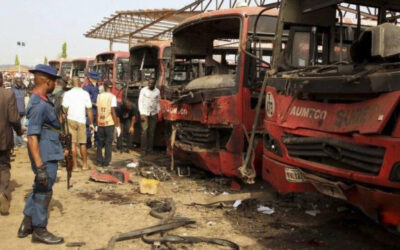
The Nigeria Precedent: Why Degrading One Group Won’t Secure Mali
🔒 Subscriber-Only Analysis This in-depth report is reserved exclusively for clients subscribing to The North Africa Journal. 👤 Already a subscriber? Log in here Not a subscriber? Click here for our lowest...
Nigeria: More than 160 people killed in Muslim communities in Kwara State
🔒 Subscriber-Only Analysis This in-depth report is reserved exclusively for clients subscribing to The North Africa Journal. 👤 Already a subscriber? Log in here Not a subscriber? Click here for our lowest...
Nigeria Adjusts Airstrike Strategy Under Expanded U.S. Security Cooperation
🔒 Subscriber-Only Analysis This in-depth report is reserved exclusively for clients subscribing to The North Africa Journal. 👤 Already a subscriber? Log in here Not a subscriber? Click here for our lowest...