🔒 Subscriber-Only Analysis This in-depth report is reserved exclusively for clients subscribing to The North Africa Journal. 👤 Already a subscriber? Log in here Not a subscriber? Click here for our lowest...
MEA RISK’s SHIELD & ALERT notifications: Access requires installing Shield & Alert mobile application. More info on S&A here or click here to signup and install
Nigeria Adjusts Airstrike Strategy Under Expanded U.S. Security Cooperation
🔒 Subscriber-Only Analysis This in-depth report is reserved exclusively for clients subscribing to The North Africa Journal. 👤 Already a subscriber? Log in here Not a subscriber? Click here for our lowest...
Nigeria: Questions Mount Over U.S. Airstrikes in Northern Nigeria
🔒 Subscriber-Only Analysis This in-depth report is reserved exclusively for clients subscribing to The North Africa Journal. 👤 Already a subscriber? Log in here Not a subscriber? Click here for our lowest...
U.S. Immigration Policy and the Changing Landscape of Africa-U.S. Travel
🔒 Subscriber-Only Analysis This in-depth report is reserved exclusively for clients subscribing to The North Africa Journal. 👤 Already a subscriber? Log in here Not a subscriber? Click here for our lowest...
Nigerian president Tinubu under pressure to avoid war with northern neighbor Niger
By Camille Malpat with Aminu Abubakar in Kano, Nigeria: Political leaders in Nigeria are urging President Bola Tinubu to reconsider a threatened military intervention against junta leaders in neighbouring Niger, ahead of a Sunday deadline to reinstate the country's...
Nigeria grapples with end of fuel subsidy
By Alexandre Martins Lopes: Nigerians are struggling with surging fuel prices after newly elected President Bola Tinubu declared an end to popular subsidies, a move analysts and experts said was long overdue. On his first day in office, Tinubu kept to his campaign...
Nigerian farmers take on Shell in landmark oil spill case
Posted On 12 October 2020
Lawyers for four Nigerian farmers accused Anglo-Dutch oil giant Shell on Thursday of causing widespread pollution in a landmark court case filed in the Netherlands. The farmers first filed suit in 2008, demanding Shell clean up devastating oil spills in three villages in the Niger Delta, prevent further pollution and pay compensation. Two of the farmers have since died, as Shell spent years arguing that the case, backed by Dutch environment group Milieudefensie, should not be heard in the Netherlands. Judges ruled in 2015 that the suit could go ahead, and lawyers for the farmers opened their case at The Hague Appeals court on Thursday.
The surviving farmers and their relatives watched via video link from Nigeria. “This has been a long-running case and you are aware of the subsequent problems as a result of the oil pollution in the Niger Delta,” lawyer Channa Samkalden told the three-judge panel. “But a solution still seems a long way off,” she said. Samkalden showed satellite images and played videos of three spills which occurred in the 2000s around the southeastern Nigerian villages of Goi, Oruma and Ikot Ada Udo.
The images showed gushing and burning oil spills as well as villagers dragging their hands through water sources, their hands streaked with the chemical afterwards. “The land that contained our source of income had vanished,” one of the original plaintiffs, Chief Fidelis Oguru, told journalists via video link ahead of the case. “I hope that the Dutch court will give us a favourable judgement,” said Oguru. He blamed the loss of his eyesight on spills near Oruma, one of which dumped some 150 barrels, or 24,000 litres (6,300 US gallons), of oil in the environment around 2005, according to his lawyer.
Shell has always blamed the spills on sabotage and said it has cleaned up with due care where pollution has occurred. “The law in Nigeria is clear that operators are not liable to pay compensation for the damage from sabotage spills,” Igo Weli, director of Shell’s Nigerian subsidiary, said in a statement. Nigeria was the world’s ninth-largest oil producer in 2018, pumping out volumes valued at some $43.6 billion (37 billion euros), or 3.8 percent of total global production. In a separate case in the Netherlands, the widows of four Nigerian activists executed by the military regime in the 1990s last year accused Shell of complicity in their deaths.
AFP
Recent News from Nigeria
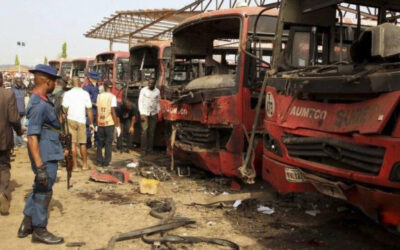
The Nigeria Precedent: Why Degrading One Group Won’t Secure Mali
🔒 Subscriber-Only Analysis This in-depth report is reserved exclusively for clients subscribing to The North Africa Journal. 👤 Already a subscriber? Log in here Not a subscriber? Click here for our lowest...
Nigeria: More than 160 people killed in Muslim communities in Kwara State
🔒 Subscriber-Only Analysis This in-depth report is reserved exclusively for clients subscribing to The North Africa Journal. 👤 Already a subscriber? Log in here Not a subscriber? Click here for our lowest...
Nigeria Adjusts Airstrike Strategy Under Expanded U.S. Security Cooperation
🔒 Subscriber-Only Analysis This in-depth report is reserved exclusively for clients subscribing to The North Africa Journal. 👤 Already a subscriber? Log in here Not a subscriber? Click here for our lowest...