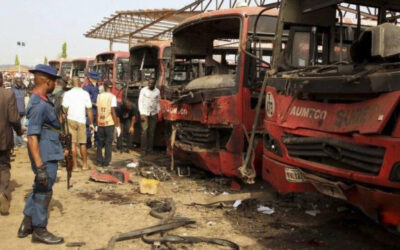
Suspected jihadists attacked a bus and a truck in southwest Niger, killing 21 people in the troubled Tillaberi region near Burkina Faso, local and security sources said on Thursday. Niger, the world’s poorest country according to the UN’s Human Development Index, is fighting extremists on multiple fronts.
Tillaberi is located in the flashpoint “three borders” zone of Niger, Burkina and Mali, where jihadist groups linked to Al-Qaeda and the Islamic State in the Greater Sahara (ISGS) operate. “A terrorist attack on Wednesday afternoon by heavily armed men travelling on motorcycles and in a vehicle killed 19 people travelling in a bus, including two police officers,” a security source said. “Two others were killed in an attack on a truck,” added the source, who asked to remain anonymous.
They burned to death when the truck, carrying fruit and vegetables, was set on fire. Five people including a policeman were wounded in the attack on the bus, which was also torched. They were taken to the capital, Niamey, for treatment, the source said. Seven passengers — four women and three men — managed to escape from the bus.
The attack occurred near the Petelkole border post, 10 kilometres (six miles) from the border with Burkina, a local official said. In October 2021, three police officers were killed and several others wounded in a suspected jihadist attack on the Petelkole border post. The Nigerien Modern Transport Company confirmed one of its buses “returning from Ouagadougou was the subject of a deadly attack” in a statement. “After this unfortunate event, we inform our customers that departures to Burkina Faso are suspended until further notice,” added the company, one of the country’s largest serving multiple western African capitals.
Since 2017, western Niger has been regularly targeted by Islamist groups, despite the deployment of thousands of anti-jihadist troops and the imposition of a state of emergency. Nigerien President Mohamed Bazoum has previously said 12,000 of the country’s soldiers are involved full-time in anti-jihadist operations. Earlier this month, five soldiers were killed by a mine in Niger’s southwestern Torodi region, where jihadist attacks using improvised explosive device (IEDs) are increasingly frequent. And in southeastern Niger, suspected jihadists from Nigeria’s Boko Haram group killed 10 people in villages near the town of Diffa this month. Bazoum announced late February the start of “discussions” with jihadists as part of “the search for peace.”