
Maghreb Edition

Algeria’s political police unleash terror on journalists and othersF

Posted On 5 April 2020

Number of times this article was read : 391

Journalist Meriem Chorfi, Editor-in-chief Mouhoub Rafik, and Mohamed Laamari, the Publisher of Algerian newspaper Sawt Al Akher were placed on Thursday, 2 April under judicial control. The move is the last step before they are dragged into a court, most likely the one in Algiers’ Sidi M’Hamed, which has been use by the Algerian political police to punish anyone who does not toe the line to the regime.

As in all cases of reporters and social media commentators, the three victims of the Algeria justice system are being prosecuted on the basis of the bogus article 79 of the penal code “of attack national unity” and “dissemination of writings that could harm the national interest.”

The arrests confirm the escalation in attacks against journalists perpetrated by the Algerian authorities, as efforts are underway to undermine the anti-regime Hirak movement. Attacks against journalists have escalated of late, despite article 50 of the Algerian Constitution protecting journalists against government abuse.

The three victims of the Algerian political police are being prosecuted for having reported errors and faulty results Covid-19 testing by the state-controlled Pasteur Institute of Algiers. The three journalists have joined a long list of peers who are being punished for their reporting, including Khaled Drareni, Sofiane Merakchi, Said Boudour and Mustapha Bendjama.

In addition to journalists, the political police under the control of the Algerian military command and the
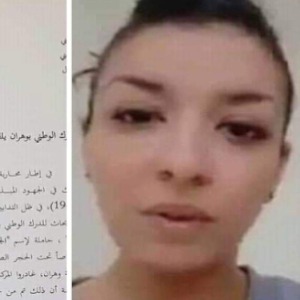
Imane Meddour

Imane Meddour: arrested and humiliated for her opinion.

intelligence services, have been tracking people who broadcast and publish comments on the Internet that the regime does not like.  Just this week, a 30-year-old woman was brutally arrested on 2 April because she published a video on social networks where she criticized the lack of seriousness of the authorities in preventing the spread of Covid-19.

The woman, Imane Meddour, stated that the authorities did nothing to vet the Algerian nationals who were repatriated from Marseilles, apart from simply lodging them in a holiday resort in Oran. The Algerian gendarmerie, the military unit that arrested her, argued in a press release that Meddour was arrested because “she questioned the efforts of the Algerian state in its fight against the coronavirus epidemic.” She is accused of spreading rumors.   As a punitive measure, the gendarmerie humiliated Meddour by parading her on Algerian television showing her arms cuffed behind her back. The affair has sparked outrage on social media in Algeria.


The North Africa Journal's WhatsApp Group
.

Most Recent Stories from the Region

Trump Sends Controversial Envoy to South Africa at a Diplomatic Low Point$

Leo Brent Bozell III has arrived in Pretoria as the new U.S. ambassador to South Africa, stepping into one of the most strained periods in bilateral relations in recent years. His appointment, amid disputes over Israel, Afrikaner rights allegations, and diplomatic expulsions, reflects a politically charged moment that could redefine the trajectory of U.S.–South Africa ties.

Algeria and Niger Relaunch Trans-Saharan Gas Pipeline After Diplomatic Freeze$

Algeria and Niger have ended months of strained relations and announced the operational launch of the Trans-Saharan Gas Pipeline, a 4,000-kilometer project linking Nigerian gas fields to European markets through Niger and Algeria. The move signals both a diplomatic reset and a renewed push to position North Africa as a strategic energy corridor.

Morocco Detains Civic Activist Amid Online Speech Concerns$

Moroccan authorities have detained Mohammed Khalif,a Casablanca-based member of the youth movement GenZ212, following a home search and seizure of his computer. Charges have not yet been publicly disclosed. His arrest comes days after another GenZ212 member was prosecuted over alleged online incitement, raising questions about the legal climate surrounding youth activism and digital expression in Morocco.

Written by The North Africa Journal

The North Africa Journal is a leading English-language publication focused on North Africa. The Journal covers primarily the Maghreb region and expands its general coverage to the Sahel, Egypt, and beyond, when events in those regions affect the broader North Africa geography. The Journal does not have any affiliation with any institution and has been independent since its founding in 1996. Our position is to always bring our best analysis of events affecting the region, and remain as neutral as humanly possible. Our coverage is not limited to one single topic, but ranges from economic and political affairs, to security, defense, social and environmental issues. We rely on our full staff analysts and editors to bring you best-in-class analysis. We also work with sister company MEA Risk LLC, to leverage the presence on the ground of a solid network of contributors and experts. Information on MEA Risk can be found at www.MEA-Risk.com.