No Results Found
The page you requested could not be found. Try refining your search, or use the navigation above to locate the post.
Note From the Editor
By Arezki Daoud
Algeria: The collapsing central state and the inevitable fall of the house of cards
By Arezki Daoud – 18 April 2019: A remnant of the Bouteflika regime, Tayeb Belaiz had the decency this week to resign under the intense pressure from the streets. He is just one card of the many that form this very fragile house of cards that is the Algerian government of today. Things look grim for the men and women that insist on keeping the house from falling, but the writing is on the wall. Just this week, if I were forced to bet about the survival of this regime in a Vegas betting parlor, I would put 85% of my money with those wagering that it would collapse soon.
In this week’s environment, the protest movement made two major victories. The President of the Constitutional Council, Tayeb Belaiz, resigned, and the top military chief Gaid Salah hinted that a different solution than what the constitution requires is totally acceptable. These are game changers, because in the first case, although Belaiz is just one of the many dominos that need to fall and does not change the terms of equation significantly, his departure is having an energizing effect, giving protesters fresh momentum after the low of last week resulting from a brutal police intervention. In the second case, the General first insisted on using an article of the constitution that clearly paves the way for a transition managed by the remnants of the Bouteflika regime. But this weeks he seemed to understand that other articles of the constitution give the people the final and ultimate say, and therefore, after millions of people took to the streets (virtually all voters) he is now open to a political solution, instead of getting stuck with a constitutional solution only.
Setting aside the discussion on where things ought to go, the current interim government is an empty shell of sort, with no substance, and greatly diminished power. Its lack of power is so scary that civil disobedience is now growing in places where the central government’s oversight is critical. With no reach into government structures on the ground, the central government is clearly collapsing. Local governments, municipalities and communes have been among the first institutions to push against the oversight of the Interior Ministry. The latter is now being directly challenged by mayors who say they no longer abide by any rules from the government. The electoral list revision for the scheduled 4 July Algerian presidential elections was slated to begin on 16 April. However, at least four mayors in the province of Bordj Bou-Arreridj rejected the task and are boycotting the preparation phase. Likewise, mayors of nine Setif municipalities have joined their peers from other provinces to reject the Ministry of the Interior’s call to prepare for the election and are now boycotting the whole process. This event is being discussed within thousands of other municipalities and without that base, the Interior Ministry cannot move forward with elections.
Equally devastating, the judiciary is following the same path. More than 100 magistrates held a rally on 13 April 2019 in front of the Ministry of Justice in Algiers also rejecting the 4th July presidential election that was announced by interim president Bensalah. Their actions come as a result of their support to the popular protest movement and for what they consider to be an illegitimate decision. They argued that this task cannot be free and fair if they are held under the same judicial framework and institutions that operated under the Bouteflika regime. They have also called for the Interim President, Abdelkader Bensalah, to resign. The Judges now say they will simply not support any election under the current circumstances.
While these government structures are quickly dropping support to the central government, the population is making it very hard to government officials to conduct business on the ground. Ministers do not feel safe doing what they always have done, that is to travel to the regions to inaugurate projects, give speeches, meet with administrators and the people. On 13 April 2019, three ministers of the Bedoui government including the Ministry of Interior, were chased out by the population in Bechar. The other ministers considered persona-non-grata included Ali Hamam, of the Water Resources Ministry, and Kamel Beldjoud of Housing. The following day, the same type of incident took place in Tebessa, where the population told a fourth minister, the Minister of Energy that he was not welcomed in their province. These acts happened although the ministers came to inaugurate projects important to the provinces such as those of water, housing and energy. Such explosive environment provides clear indications that the current regime is cornered and must find a way out soon.
This rejection of the government is not an overnight phenomenon. While risk analysts often focus their research on physical threats such as terrorism in assessing the stability of a country, the real sources of instability are often neglected, providing a false picture of a country. MEA Risk LLC data shows that terrorism activity in Algeria has largely been eradicated. This does not mean the risk is non-existent. It is absolutely what pushes the Algeria military to adjust its strategy to counter the risks from various militant groups, both domestic and regional. But a bird’s eye view of the sources of crises shows that terrorism is secondary. For those who prefer visuals and graphics, I borrowed maps from MEA Risk and picked two categories tracked by the company. The data clearly reveals the extent of the problems facing Algeria on the socio-economic front. The first two maps illustrate the tracked human and social-related incidents, from localized riots due to housing shortages, lack of water and electricity, environmental degradation, etc.… and one can only assess how severe the situation is, whether it was in 2018 or this year. This is compared to maps 3 and 4, showing the number of terror incidents taking place during the same periods. Again, I am not reducing the importance of the counter-insurgency campaign. It must continue as we see dangerous developments in the Sahel and Libya. But understanding the current political crisis in Algeria requires a different set of lenses.
Click on image to enlarge
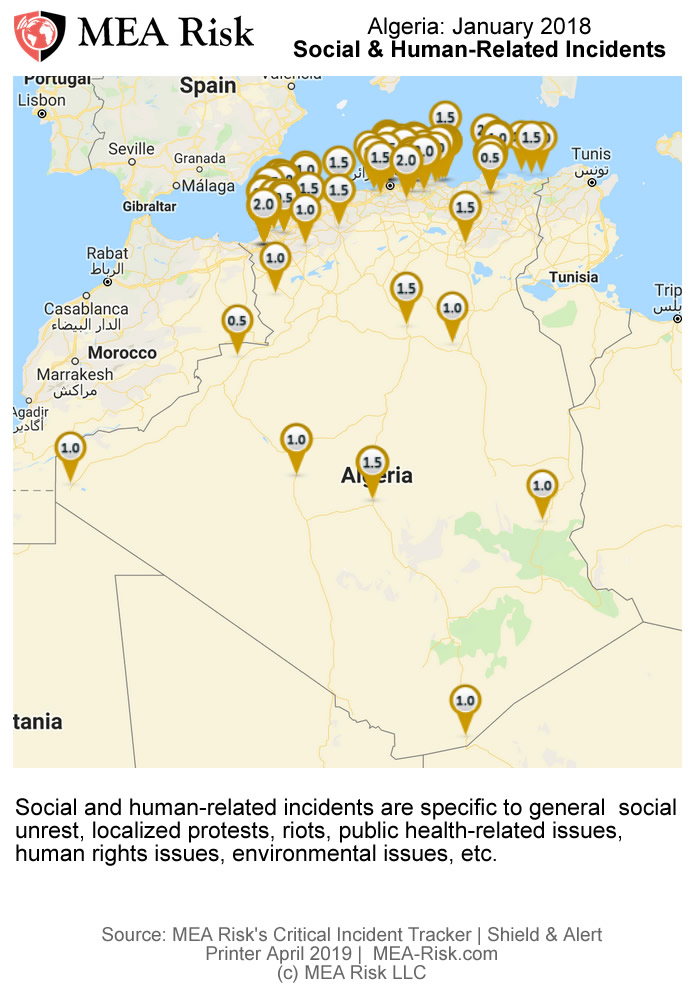
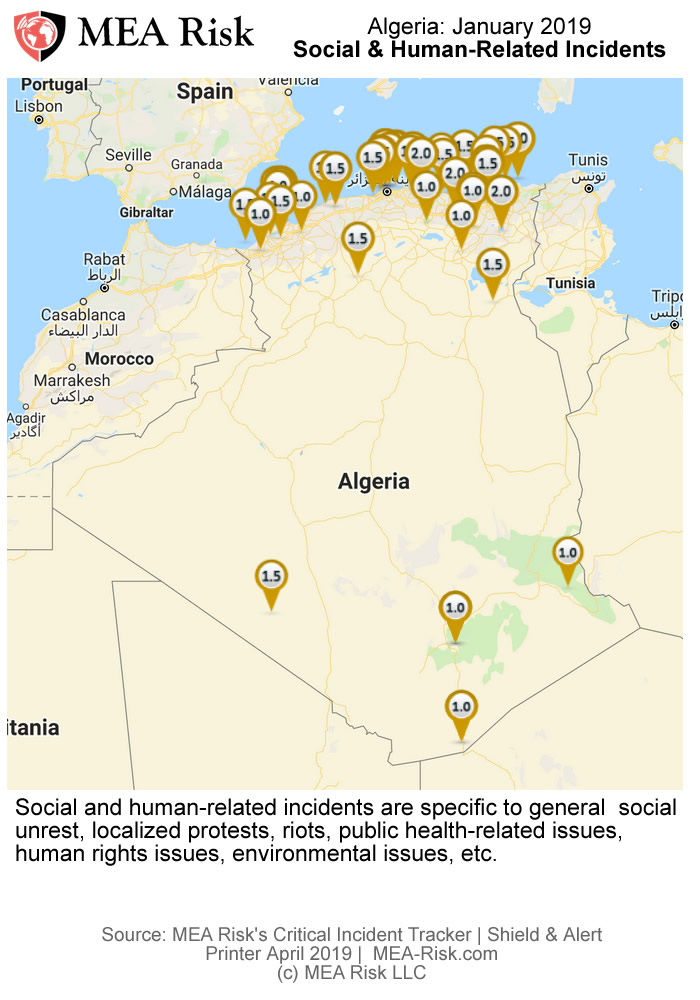
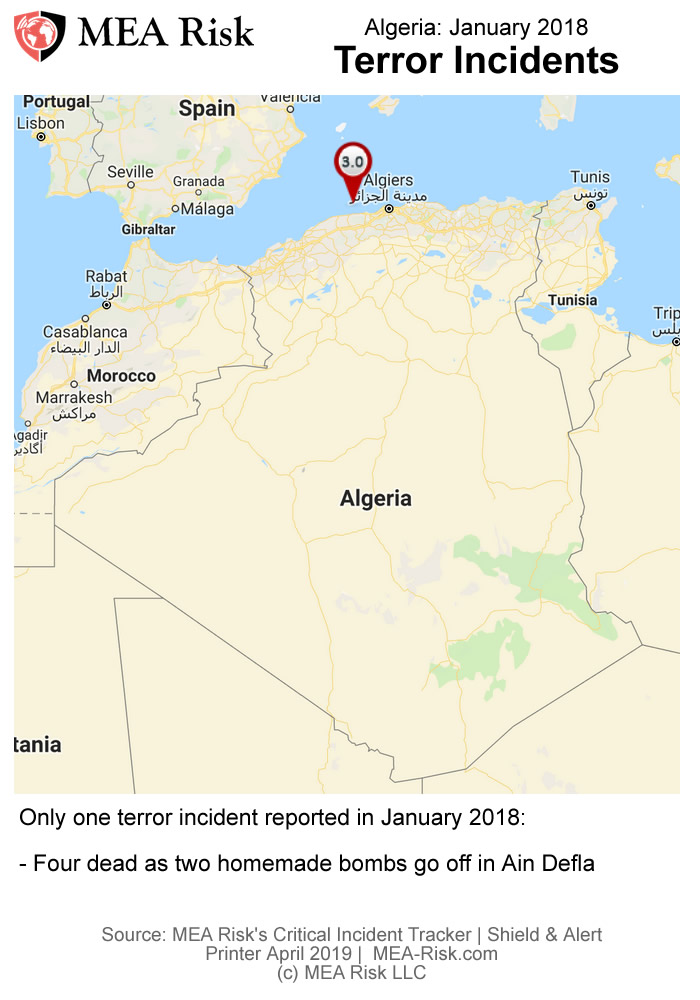
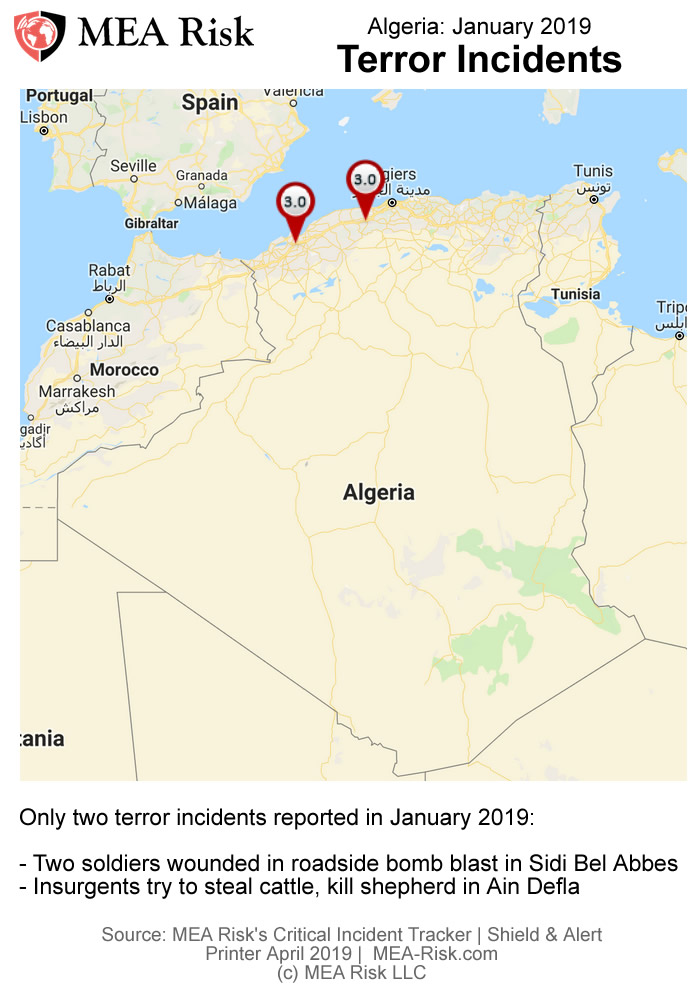
For many, maps and visuals may not be enough to understand why there is such uproar in Algeria. Let me pick just three random examples of social unrest taking place just this week that illustrate the level of despair forcing the population to rebel. MEA Risk’s tracking report the following:
Laghouat province shaken by wave of protests and strikes
Published April 17, 2019: For over a month, the province of Laghouat has experienced a wave of protests and strikes that are negatively affecting the proper functioning of several sectors. From public health to civil protection, and from housing to transportation, the delivery of basic services is being hampered by issues ranging from local politics to mismanagement, prompting stakeholders to strike. In the public health sector, various trade unions have organized on 14 April 2019 a protest action in front of the central directorate of the sector to demand the immediate departure of the Executive Director. The strikers also denounced the deplorable situation facing hospitals and public clinics, a situation they say was made worse with the appointment of the new provincial executive. The civil protection sector, at least 30 agents (fire fighters) went on strike to demand the reintegration of one of their colleagues who was allegedly suspended arbitrarily because of a comment left on Facebook. In the gas producing region of Hassi R’mel, several residents in the municipality have taken to the street to protest the fact that the housing units they purchased will not be delivered on time and as scheduled. They claim the postponement of the delivery is illegal, but the provincial justice system will not address their grievances. In the same context of a collapsing administration in Laghouat, dozens of workers of the Laghouat National Passengers Transport Company have been on strike for a month, demanding the departure of their provincial director.
Biskra: Protesters force the shutdown of two municipalities in Biskra
Two town halls were forcibly closed by protesters in Blida province. The first one was closed by angry young men who have welded the access gate in protest for the town officials’ support for agricultural companies from outside the region who allegedly received too support to the detriment of local farmers. In the second case, protesters erected a brick wall in front of the entrance gate and demanded explanations on how 100 rural housing units were distributed. They claim irregularities took place in the distribution process.
Chlef: No water for Chlef province for a week as main desalination plant struggles with technical issues
Residents of 32 municipalities in Chlef province have been deprived of drinking water since 14 April 2019, a situation that will last for at least a week, and likely beyond. Water company ADE said the situation was made necessary to fix issues at the sea-water desalination plant of Tenes. ADE said it took urgent measures to provide alternative supply methods, by tapping into Sidi Yacoub dam and public wells and using trucks to supply residents. However, analysts are concerned about the northern and coastal cities in the province, where water has been scarce. The water desalination plant of Tenes supplies water to 32 of the 35 municipalities in the province, supplying 200,000 cubic meters per day.
These are just examples of the thousand occurrences that take place weekly in the politically troubled country, where central government administrators have lost touch with practical issues on the ground, or simply didn’t care to bother. The level of dysfunction has reached such a climax that the collapse of the house of cards appears inevitable.